
Islands Near Phuket: Exploring the Island Geography Around Phuket
Thailand forms part of mainland Southeast Asia and is bordered by two very different marine environments: the Andaman Sea to the west and the Gulf of Thailand to the east. According to Thailand’s Department of Marine and Coastal Resources, the country contains approximately 1,429 islands. This figure includes everything from large inhabited islands and national parks to tiny offshore islets, limestone outcrops and remote rocky formations.
For many travellers, the journey begins with a simple dream: islands.
Perhaps you’ve seen photographs of Phi Phi, heard about James Bond Island, or watched videos of the Similan Islands. Yet the more time I spent looking at maps and exploring Phuket, the more I realised that most discussions focus on only a small part of a much larger island world.
Like many travellers, I wasn’t just interested in what tour operators happened to be selling. I wanted to know what was actually there.
How many islands surround Phuket?
Where do they sit in relation to each other?
Which islands belong to Phang Nga Bay, which lie in the open Andaman Sea, and how far south does the island chain really extend?
The answer turned out to be far more interesting than I expected.
Depending on where the boundary is drawn, the island geography surrounding Phuket stretches north towards the Surin Islands and Ranong, east into the limestone landscapes of Phang Nga Bay, south through Phi Phi and Krabi, and eventually towards Koh Lipe and the Malaysian border. Some islands are famous. Others receive little attention. Some are thriving communities, while others are little more than dramatic formations rising from the sea.
This guide is not intended to tell you which island you should visit. Instead, it aims to help you understand what exists. Using geographic, marine and tourism sources, I’ve compiled and organised the major island systems surrounding Phuket into a framework that makes them easier to visualise and explore.
Whether you’re actively planning a trip or simply curious about the geography of the Andaman coast, my goal is simple: to help you see the bigger picture before deciding where your own adventure might lead.
Understanding Phuket’s Position in Thailand’s Island Geography
To understand the islands near Phuket, it helps to first understand where Phuket sits within Thailand’s wider geography.
Thailand’s islands are generally divided between two very different marine environments. To the east lies the Gulf of Thailand, home to islands such as Koh Samui, Koh Phangan and Koh Tao. To the west lies the Andaman Sea, a region known for its limestone cliffs, island chains, coral reefs and dramatic coastal scenery.
Phuket sits on Thailand’s Andaman coast and occupies a unique position within this wider island landscape. Rather than being surrounded by a single island group, Phuket lies at the centre of several distinct island systems.
To the northwest are the more remote islands of the Northern Andaman, including the Similan and Surin Islands. To the east lies Phang Nga Bay, a sheltered world of limestone karsts, hidden lagoons and hundreds of islands scattered across protected waters. To the south, a long island chain stretches towards Krabi, Trang and eventually the Malaysian border. Closer to Phuket itself are dozens of smaller islands that are often overshadowed by their more famous neighbours.
This geography helps explain why Phuket has become one of Southeast Asia’s most important island gateways. Within a relatively small area, travellers can experience dramatically different island environments. Some islands are remote national parks. Others are inhabited communities. Some are famous international destinations, while others rarely appear in guidebooks.
As I worked through maps, marine charts and island inventories, I found it helpful to stop thinking about individual islands and instead think about island systems. Once the islands are grouped into their natural geographic regions, the wider picture becomes much easier to understand.
The map below shows the simple framework that I use to visualise the islands surrounding Phuket.
A Simple Way to Visualise the Islands Near Phuket
One of the challenges I encountered while researching the islands near Phuket was that there are simply too many islands to remember individually.
Maps quickly become crowded with names, and before long it becomes difficult to understand how the different island groups relate to each other. I found it much easier to stop thinking about individual islands and instead think about the wider island systems that surround Phuket.
Using Phuket as the centre point, the islands can be broadly divided into four geographic regions.
Northwest of Phuket: The Northern Andaman
This region contains some of the most remote islands in the wider Phuket area, including the Similan Islands, Surin Islands and several island groups off the coast of Ranong and northern Phang Nga.
These islands generally face the open Andaman Sea and are more exposed to ocean conditions than many of the islands closer to Phuket.
East of Phuket: Phang Nga Bay
To the east lies the sheltered world of Phang Nga Bay.
This region contains famous destinations such as James Bond Island, Koh Panyee, Hong Island and the Yao Islands, along with dozens of smaller limestone islands scattered throughout the bay.
Compared with the open Andaman Sea, these waters are generally more protected and form one of Thailand’s most distinctive island landscapes.
Around Phuket: The Local Islands
Many travellers are surprised to discover how many islands sit immediately around Phuket itself.
This region includes islands such as Coconut Island, the Naka Islands, Rang Yai, Koh Lon and Maiton Island.
While they often receive less attention than Phi Phi or the Similan Islands, they form an important part of Phuket’s island geography.
South of Phuket: The Southern Island Chain
Looking south from Phuket, a long chain of islands stretches through Phi Phi and Krabi before continuing towards Trang and eventually the Malaysian border.
This region includes many of Thailand’s most famous island destinations, but it also contains numerous lesser-known islands that receive far less attention from international visitors.
Once these four regions are understood, the wider island geography surrounding Phuket becomes much easier to visualise. Rather than seeing dozens of disconnected islands, it becomes possible to see a series of interconnected island systems that each have their own character, geography and appeal.
Northwest of Phuket: The Northern Andaman
If Phang Nga Bay represents Phuket’s sheltered limestone world, the Northern Andaman represents almost the opposite experience.
Stretching north and northwest from Phuket towards Ranong, this region contains some of the most remote islands in Thailand’s Andaman Sea. Unlike the islands within Phang Nga Bay, many of these islands face the open ocean and are more exposed to weather, waves and seasonal conditions.
For travellers, this part of the Andaman often feels wilder and more remote. Distances are greater, island groups are more widely separated, and several of the region’s most famous destinations are protected national parks.
The Northern Andaman can be broadly divided into four smaller areas: the Similan Islands, the Surin Islands, the islands off the Ranong coast, and a collection of lesser-known islands along the northern Phang Nga coastline.
The Similan Islands
The Similan Islands are perhaps the most famous islands within the Northern Andaman region.
Located well offshore from the mainland, the Similan Islands are known for their clear water, dramatic granite formations and marine life. They are often regarded as one of Thailand’s premier snorkelling and diving destinations.
While many visitors associate the Similan Islands with Phuket, they sit considerably further north and are typically reached via speedboat departures from the Khao Lak area.
The Surin Islands
Further north again lie the Surin Islands.
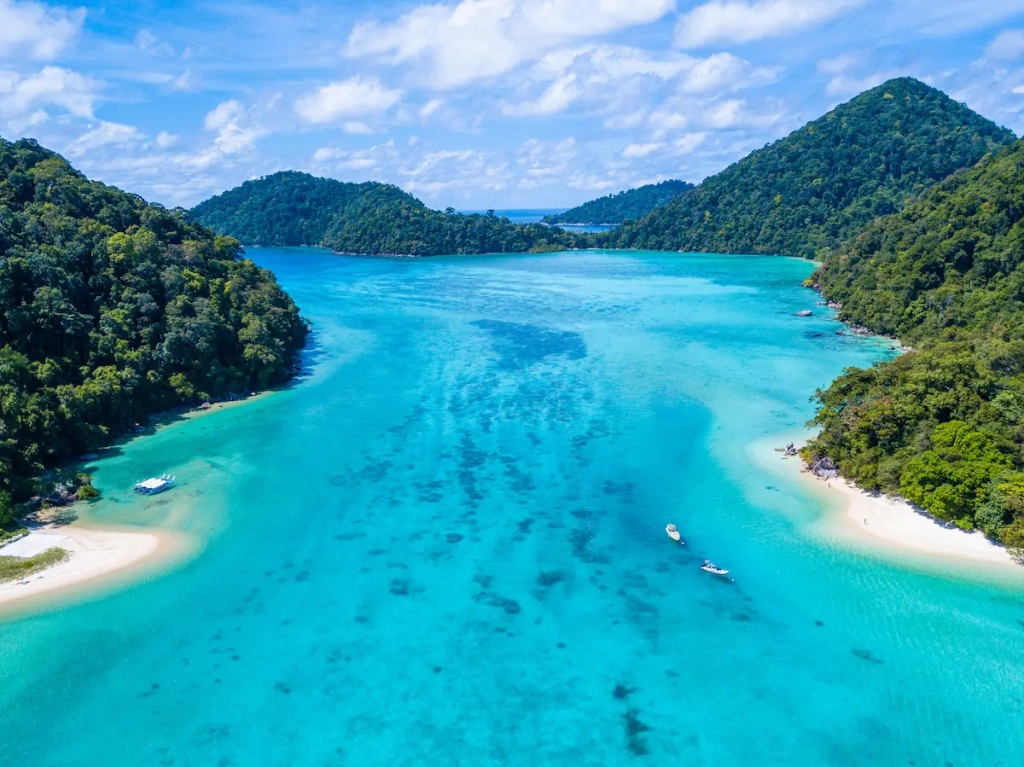
Located close to the Myanmar border, the Surin archipelago is among the most remote island groups commonly visited from Phuket and the surrounding region.
The islands form part of Mu Ko Surin National Park and are known for their coral reefs, marine life and relatively undeveloped character.
For many travellers, the Surin Islands represent the outer edge of Phuket’s practical island world.
The Ranong Islands
North of Phuket and beyond the Surin Islands, the island geography continues into Ranong Province.
Islands such as Koh Phayam and the Koh Kam group receive far less international attention than Phi Phi or the Similans, yet they form an important part of the wider Northern Andaman landscape.
These islands remind us that Phuket’s island geography does not simply stop where tourism marketing ends.
Northern Phang Nga Coast Islands
Between Phuket and the Surin Islands sits another group of islands that are rarely discussed in travel guides.
Islands such as Koh Ra, Koh Phra Thong and Koh Kho Khao lie off the northern Phang Nga coastline and help connect Phuket’s island geography to the wider Northern Andaman region.
While they may not be household names among international visitors, they play an important role in understanding the broader island landscape that surrounds Phuket.
Taken together, the islands of the Northern Andaman form one of the most distinctive island regions in Thailand. They are generally more remote, more exposed to open sea conditions and more closely associated with nature, marine environments and national parks than many of the island groups found closer to Phuket itself.
East of Phuket: Phang Nga Bay
If the Northern Andaman is defined by open water and remote island groups, the islands east of Phuket belong to a very different world.
Phang Nga Bay is one of the most distinctive coastal landscapes in Southeast Asia. Rather than open ocean, the bay is characterised by sheltered waters, towering limestone formations, hidden lagoons and hundreds of islands scattered throughout the region.
For many visitors, this is the image most closely associated with Thailand’s dramatic island scenery.
The geography of Phang Nga Bay also creates a noticeably different experience from the islands found further offshore. Because many of the islands are protected by surrounding landforms, the waters are often calmer than those found in the open Andaman Sea. The focus here is less about long stretches of white sand and more about exploration, scenery and discovering unusual landscapes.
The Yao Islands
Among the largest islands in the bay are Koh Yao Yai and Koh Yao Noi.
Unlike many islands that are primarily visited on day trips, the Yao Islands are destinations in their own right. Home to local communities, accommodation and quiet coastal scenery, they offer a very different experience from the faster-paced island tours that many travellers associate with Phuket.
They also occupy an important geographic position, sitting between Phuket and Krabi at the heart of Phang Nga Bay.
Hong Island and the Limestone Karsts
Some of the bay’s most famous scenery is found around islands such as Hong Island and Panak Island.
These areas are known for dramatic limestone cliffs, hidden lagoons, sea caves and narrow channels that can only be accessed under certain tidal conditions.
For many travellers, this part of Phang Nga Bay represents exploration rather than simply visiting a beach.
Koh Panyee
One of the most unusual islands in the region is Koh Panyee.
Built around a traditional fishing community, the island demonstrates that not every island in the Phuket region is defined by tourism or beaches. It remains an important reminder that many of the islands surrounding Phuket are living communities with their own history and culture.
James Bond Island
No discussion of Phang Nga Bay would be complete without mentioning James Bond Island.
Although the island itself is relatively small, its appearance in The Man with the Golden Gun helped introduce Phang Nga Bay to an international audience and remains one of the region’s most recognised landmarks.
In many ways, James Bond Island acts as a gateway to a much larger story. Beyond the famous photograph lies an extensive network of islands, limestone formations and waterways that make up the wider geography of Phang Nga Bay.
The Smaller Islands of the Bay
Beyond the famous names are dozens of lesser-known islands scattered throughout the bay.
Many appear as isolated limestone formations rising from the water, while others are larger islands that rarely receive the same attention as Hong Island or Koh Yao Noi. Together they form a complex landscape that is best understood as a connected island system rather than a collection of individual destinations.
For travellers interested in scenery, exploration, limestone landscapes and sheltered waters, Phang Nga Bay represents one of the most distinctive island regions surrounding Phuket. It is also one of the easiest areas to visualise on a map, with the islands forming a natural bridge between Phuket, Krabi and the mainland coast.
Around Phuket: The Local Islands
When people think about the islands near Phuket, their attention is usually drawn towards famous destinations such as Phi Phi, James Bond Island or the Similan Islands. As a result, many visitors overlook the islands that sit immediately around Phuket itself.
Yet some of the closest islands to Phuket are also among the easiest to access.
Scattered around Phuket’s coastline are a collection of smaller islands that form what I think of as Phuket’s local island system. While they may not have the international reputation of Phi Phi or the dramatic limestone landscapes of Phang Nga Bay, they play an important role in understanding the wider geography surrounding Phuket.
Coconut Island
Located just off Phuket’s east coast, Coconut Island is one of the closest inhabited islands to Phuket.
Its proximity to the mainland means it often feels more connected to Phuket than many visitors realise, yet it remains geographically separate and forms part of Phuket’s wider island landscape.
The Naka Islands
North-east of Phuket lie Koh Naka Yai and Koh Naka Noi.
Positioned between Phuket and the entrance to Phang Nga Bay, these islands occupy an interesting transition zone between Phuket’s local islands and the wider bay system.
Rang Yai and Rang Noi
The Rang Islands sit just offshore from Phuket’s east coast and are among the islands most frequently visited on shorter excursions.
Their location helps demonstrate how densely populated the waters around Phuket are with islands, many of which receive little attention compared with the region’s more famous destinations.
Koh Lon
To the south-east of Phuket, Koh Lon occupies another often-overlooked position within Phuket’s local island geography.
While many travellers pass through the area on their way to larger destinations, the island forms part of the network of islands that surround Phuket itself.
Maiton Island
Maiton Island perhaps best illustrates the idea that not every island needs to be far from Phuket to feel distinct.
Although located relatively close to the main island, Maiton sits in more open water and begins to hint at the island environments found further south towards Coral Island, Racha and Phi Phi.
Understanding Phuket’s Local Islands
Unlike the Northern Andaman or Phang Nga Bay, Phuket’s local islands are not defined by a single dramatic characteristic.
Instead, their significance comes from their proximity to Phuket itself.
Together they form a bridge between the main island and the larger island systems that surround it. They also remind us that Phuket is not an isolated island sitting alone in the Andaman Sea, but rather the centre of a much larger network of islands, channels and coastal landscapes.
For travellers, these islands offer a glimpse of the diversity that exists even before venturing further afield. For anyone trying to understand Phuket’s geography, they are an important piece of the puzzle that is often overlooked in favour of more famous destinations.
South of Phuket: The Southern Island Chain
If Phang Nga Bay represents Phuket’s sheltered limestone world and the Northern Andaman represents its remote frontier, the islands south of Phuket tell a different story altogether.
Rather than a collection of isolated island groups, the islands south of Phuket can be viewed as part of a long island chain that stretches down Thailand’s Andaman coast towards Malaysia.
Many visitors encounter only a small part of this chain. They might visit Phi Phi on a day trip or spend time on the Racha Islands, often without realising that these destinations form part of a much larger island landscape that continues for hundreds of kilometres.
Once viewed on a map, the pattern becomes difficult to ignore.
Coral Island and the Racha Islands
The southern journey begins close to Phuket itself.
Coral Island and the Racha Islands sit south of Phuket in increasingly open water and mark the transition away from Phuket’s local islands and into the wider Andaman Sea.
Compared with the sheltered waters of Phang Nga Bay, these islands are more strongly associated with beaches, snorkelling, clear water and marine environments.
For many travellers, they represent the first step into Phuket’s southern island world.
The Phi Phi Islands
Further south lies the most famous island group in the region.
The Phi Phi Islands have become synonymous with Thailand’s island scenery and are often one of the first destinations travellers associate with Phuket.
Yet from a geographic perspective, Phi Phi is perhaps even more interesting.
Rather than being an isolated destination, the islands sit almost halfway between Phuket and Krabi, acting as a bridge between the two regions.
Seen in this context, Phi Phi becomes less of a standalone attraction and more of a central link within the wider Southern Island Chain.
The Krabi Offshore Islands
Continuing south-east, the island geography merges into the offshore islands of Krabi.
Islands such as Hong Island (Krabi), Chicken Island, Poda Island and Pak Bia form another distinctive island cluster, combining beaches, limestone scenery and shallow coastal waters.
Although these islands are often marketed separately from Phuket, they form part of the same connected coastal landscape.
The provincial boundary may change, but the geography does not.
Koh Jum: The Overlooked Connector
One island that particularly caught my attention during this research was Koh Jum.
Overshadowed by both Phi Phi and Koh Lanta, Koh Jum occupies an interesting position between the two.
It rarely appears in mainstream discussions about Thailand’s islands, yet geographically it acts almost like a stepping stone linking the northern and southern parts of the chain.
Its presence is a useful reminder that some of the most interesting islands are not always the most famous.
Koh Lanta and the Southern Andaman
Further south, the island chain expands again around Koh Lanta.
For many travellers, Koh Lanta represents the point where Phuket’s immediate island world begins to blend into the broader Andaman coast of southern Thailand.
The pace often becomes slower, distances become greater and the focus shifts away from day trips towards longer stays and island-hopping journeys.
Trang’s Island Groups
South of Koh Lanta, the chain continues through islands such as Koh Ngai, Koh Mook, Koh Kradan and Koh Libong.
These islands receive far less international attention than Phi Phi, yet they remain part of the same broader island geography.
Together they demonstrate just how extensive the Andaman island chain becomes once you look beyond the destinations most frequently featured in travel brochures.
Following the Chain South
What makes the Southern Island Chain so fascinating is not any single island, but the way the islands connect together.
Starting from Phuket, it is possible to trace a continuous sequence of islands stretching south through Racha, Phi Phi, Krabi, Koh Jum, Koh Lanta and beyond.
For travellers, this creates almost endless opportunities for exploration.
For anyone interested in geography, it reveals that Phuket is not simply surrounded by a few famous islands. Instead, it sits near the northern end of one of Southeast Asia’s most remarkable island chains.
Beyond Phuket: The Wider Andaman Island World
While researching the islands near Phuket, one question kept appearing.
Where do you stop?
The answer depends entirely on how the boundary is defined.
If the goal is to identify islands that are commonly visited from Phuket, then destinations such as Phi Phi, Phang Nga Bay and the Similan Islands provide a natural limit.
However, if the goal is to understand the wider island geography surrounding Phuket, the picture becomes much larger.
The Andaman island chain does not end at Phi Phi or Koh Lanta.
Instead, it continues south through Trang Province and eventually reaches some of Thailand’s most remote and celebrated islands.
Koh Lipe and the Adang-Rawi Archipelago
Among the most famous of these southern islands is Koh Lipe.
Frequently featured in travel photography and social media, Koh Lipe has developed a reputation as one of Thailand’s most beautiful island destinations.
Geographically, however, it sits far beyond Phuket’s practical day-trip region.
Located close to the Malaysian border, Koh Lipe forms part of the Adang-Rawi Archipelago, a separate island system within the wider Andaman Sea.
Tarutao National Marine Park
Nearby lies Koh Tarutao and the islands of Tarutao National Marine Park.
This region represents one of the southernmost island groups in Thailand’s Andaman Sea and marks the continuation of the island chain that begins hundreds of kilometres further north.
Although rarely considered part of a typical Phuket itinerary, these islands help demonstrate the scale of the wider Andaman island world.
Why Include Them?
Some readers may wonder why islands such as Koh Lipe or Tarutao appear in a guide focused on Phuket.
The answer is simple.
This article is not intended to be a list of practical day trips. It is an attempt to understand the geography surrounding Phuket and the wider island systems of Thailand’s Andaman coast.
While most visitors will never travel from Phuket to Koh Lipe in a single day, many travellers are naturally curious about what lies beyond the destinations most commonly promoted by tour operators.
Understanding the wider geography helps place Phuket within its proper context.
Rather than sitting at the centre of a handful of famous islands, Phuket occupies a position within a much larger island landscape that stretches from the remote islands of the Northern Andaman all the way to the Malaysian border.
For me, that broader perspective is part of what makes exploring the geography so fascinating.
What Are the Most Famous Islands Near Phuket?
After exploring the wider island geography surrounding Phuket, a natural question remains: which islands are the most famous?
The answer depends on what attracts you.
Some islands are known for dramatic scenery, others for beaches, marine life or cultural significance. While this article focuses on understanding the broader island landscape rather than ranking destinations, a handful of islands consistently appear in discussions about Phuket and the Andaman coast.
Phi Phi Islands
Perhaps the most internationally recognised island group near Phuket, the Phi Phi Islands are famous for their limestone scenery, turquoise water and iconic beaches.
For many travellers, Phi Phi represents the image they associate with Thailand’s tropical islands.
James Bond Island
Located within Phang Nga Bay, James Bond Island became internationally famous after appearing in The Man with the Golden Gun.
Although relatively small, it remains one of Thailand’s most photographed island landmarks.
Similan Islands
Located in the Northern Andaman, the Similan Islands are widely regarded as one of Thailand’s premier marine destinations.
They are particularly well known among divers and snorkellers for their clear water and marine life.
Surin Islands
Further north than the Similans, the Surin Islands are known for their remote location, national park status and relatively undeveloped character.
They are often considered one of the most pristine island groups accessible from the Phuket region.
Koh Yao Noi and Koh Yao Yai
Situated in the heart of Phang Nga Bay, the Yao Islands offer a different perspective on island life.
Unlike many islands that are primarily visited on day trips, they are destinations where travellers can stay, explore and experience local communities.
Racha Islands
South of Phuket, the Racha Islands have become popular for their clear water, beaches and marine environments.
They represent an important part of Phuket’s southern island geography and are often among the first offshore islands explored by visitors.
Looking Beyond the Famous Names
What surprised me most during this research was not how famous these islands are, but how much island geography exists beyond them.
While destinations such as Phi Phi, James Bond Island and the Similans dominate travel conversations, they represent only a small part of the wider island landscape surrounding Phuket.
Understanding where these islands fit within the bigger picture helps reveal a much richer and more diverse island world than most travellers ever realise exists.
Complete List of Islands Near Phuket
One of the goals of this guide was to move beyond the handful of islands that dominate most travel conversations and build a broader picture of Phuket’s surrounding island geography.
During the research process, I identified 102 islands and island destinations across the major island systems surrounding Phuket. This inventory was compiled using a combination of geographic, marine and tourism sources and then organised into the regional framework used throughout this guide.
It is important to note that island classification is not always straightforward. Depending on how boundaries are drawn, whether small rocky outcrops are included, and how different sources classify island groups, there will always be room for interpretation. The Andaman coast contains countless unnamed rocks, reefs and minor formations that fall outside the scope of this article.
Rather than attempting to catalogue every feature that rises above sea level, the aim was to create the most comprehensive practical inventory of islands surrounding Phuket that I could assemble through publicly available sources.
The islands below are organised into four broad geographic regions:
- Northwest of Phuket – Northern Andaman
- East of Phuket – Phang Nga Bay
- Around Phuket – Local Islands
- South of Phuket – Southern Island Chain
Together, these regions help explain how Phuket sits within a much larger island landscape stretching from the remote islands of the Northern Andaman to the southern reaches of Thailand’s Andaman coast.
If you know of an island, island group or geographic source that you believe should be included, I would genuinely love to hear from you. One of the reasons for publishing this inventory is to continue improving and expanding it over time. Feel free to get in touch via the Contact page and I will happily review any additions, corrections or alternative sources for future updates.
The following inventory represents Version 1 of that effort.
Northwest of Phuket – Northern Andaman (28 Islands)
The Northern Andaman forms the northwestern corner of Phuket’s island geography and contains some of the most remote islands commonly associated with the wider Phuket region.
Unlike the sheltered waters of Phang Nga Bay, many of these islands face the open Andaman Sea and are more exposed to weather, waves and seasonal conditions. This region is home to Thailand’s most famous marine national parks, including the Similan and Surin Islands, along with lesser-known island groups scattered along the coasts of Ranong and northern Phang Nga.
For travellers, the Northern Andaman is often associated with clear water, marine life, national parks and a stronger sense of remoteness than many of the islands found closer to Phuket.
Ranong Islands (6)
- Koh Phayam
- Koh Chang (Ranong)
- Koh Sin Hai
- Koh Dom
- Koh Plai
- Koh Talu
Koh Kam Group (4)
- Koh Kam
- Koh Kam Tok
- Koh Kam Yai
- Koh Kam Nui
Northern Phang Nga Coast Islands (5)
- Koh Ra
- Koh Phra Thong
- Koh Kho Khao
- Koh Kad
- Koh Thung Nang Dam
Surin Islands (5)
- Koh Surin Nuea
- Koh Surin Tai
- Koh Ri
- Koh Kai
- Koh Klang
Similan Islands (8)
- Koh Similan
- Koh Bangu
- Koh Payu
- Koh Miang
- Koh Payang
- Koh Huyang
- Koh Tachai
- Koh Bon
Regional Total: 28 Islands
East of Phuket – Phang Nga Bay (29 Islands)
Phang Nga Bay forms the eastern side of Phuket’s island geography and is one of the most distinctive coastal landscapes in Thailand.
Unlike the more exposed islands of the Northern Andaman, the islands of Phang Nga Bay sit within sheltered waters surrounded by limestone cliffs, hidden lagoons and dramatic karst formations. Many of the region’s most recognisable landmarks, including James Bond Island and Koh Panyee, are found here.
For travellers, Phang Nga Bay is often associated with exploration, scenery, sea caves, limestone landscapes and calmer waters than those found in the open Andaman Sea.
Phuket East Coast Islands (12)
- Coconut Island (Koh Maphrao)
- Koh Naka Yai
- Koh Naka Noi
- Koh Rang Yai
- Koh Rang Noi
- Koh Lon
- Koh Raet
- Koh Tapao
- Koh Kaeo
- Koh Kaeo Yai
- Koh Yao Yai
- Koh Yao Noi
Upper Phang Nga Bay Islands (17)
- Koh Panyee
- Koh Hong (Phang Nga)
- Koh Panak
- James Bond Island (Koh Tapu)
- Koh Ping Kan
- Koh Nom Sao
- Koh Mak
- Koh Dang
- Koh Kudu Yai
- Koh Nui
- Koh Boi Yai
- Koh Boi Noi
- Koh Rai
- Koh Batang
- Koh Sup
- Koh Nakaya
- Koh Rung Nok
Regional Total: 29 Islands
Around Phuket – Local Islands (3 Islands)
Although many visitors focus on famous destinations further afield, Phuket itself is surrounded by a number of nearby islands that form part of its immediate island environment.
These islands are among the closest offshore destinations to Phuket and act as a transition between the main island and the wider Andaman Sea. While smaller in number than the major island systems surrounding Phuket, they remain an important part of understanding Phuket’s geography.
Local Phuket Islands (3)
- Coral Island (Koh Hae)
- Koh Bon
- Maiton Island
Regional Total: 3 Islands
South of Phuket – Southern Island Chain (42 Islands)
The Southern Island Chain is the largest island region surrounding Phuket and stretches south through Phi Phi, Krabi, Koh Lanta and beyond.
Rather than a collection of isolated island groups, this region can be viewed as a continuous chain extending along Thailand’s Andaman coast. Many of Thailand’s most famous islands are found here, but so too are numerous lesser-known islands that rarely appear in mainstream travel guides.
For travellers, this region is often associated with beaches, island hopping, snorkelling, marine environments and some of the country’s most iconic island scenery.
Racha Islands (2)
- Racha Yai
- Racha Noi
Phi Phi Islands (6)
- Phi Phi Don
- Phi Phi Leh
- Bamboo Island
- Mosquito Island
- Bida Nok
- Bida Noi
Krabi Offshore Islands (9)
- Hong Island (Krabi)
- Pak Bia
- Lao Lading
- Chicken Island
- Poda Island
- Koh Ngang
- Koh Kapang
- Koh Chong Lat
- Koh Phudu Yai
Koh Jum Transition Group (3)
- Koh Jum
- Koh Pu
- Koh Siboya
Koh Lanta Group (7)
- Koh Lanta Yai
- Koh Lanta Noi
- Koh Bu Bu
- Koh Po
- Koh Klang
- Koh Ma
- Koh Ha
Trang Islands (8)
- Koh Rok Nok
- Koh Rok Nai
- Koh Ngai
- Koh Mook
- Koh Kradan
- Koh Libong
- Koh Lao Liang
- Koh Sukhon
Far Southern Andaman Islands (7)
- Koh Tarutao
- Koh Adang
- Koh Rawi
- Koh Lipe
- Koh Dong
- Koh Bulon
- Koh Saray
Regional Total: 42 Islands
Final Thoughts
When most people think about the islands near Phuket, they picture a handful of famous destinations. Phi Phi, James Bond Island, the Similan Islands and perhaps one or two others are often enough to dominate the conversation.
Yet as this research demonstrates, the reality is far more extensive.
From the remote islands of the Northern Andaman to the limestone landscapes of Phang Nga Bay, from Phuket’s local islands to the long Southern Island Chain stretching towards Malaysia, Phuket sits at the centre of one of Southeast Asia’s most fascinating island environments.
In compiling this guide, I identified 102 islands and island destinations spread across four major geographic regions. Some are internationally famous. Others receive little attention from visitors. Some are thriving communities, while others are little more than dramatic formations rising from the sea. Together, however, they reveal a much richer picture of Phuket’s surrounding geography than most travellers ever encounter.
For me, that is perhaps the most rewarding discovery.
The purpose of this guide was never to tell you which island you should visit. Instead, it was to understand what exists. Once we understand the landscape, we can make better decisions about where we want our own journeys to lead.
Whether your interests lie in the remote national parks of the Northern Andaman, the limestone worlds of Phang Nga Bay, the famous islands of Phi Phi, or the lesser-known corners of Thailand’s Andaman coast, every island tells part of a much larger story.
And perhaps that is the greatest lesson of all.
The islands surrounding Phuket are not simply a collection of destinations. They form an interconnected island world waiting to be explored.
This guide is only the beginning.
Frequently Asked Questions
How many islands are near Phuket?
There is no universally agreed number because it depends on how the boundary is defined and whether small rocky outcrops are included. During the research for this guide, I identified 102 islands and island destinations across the major island systems surrounding Phuket.
What are the most famous islands near Phuket?
The most famous islands near Phuket include the Phi Phi Islands, James Bond Island, the Similan Islands, the Surin Islands, the Racha Islands and the Yao Islands. However, these well-known destinations represent only a small part of the wider island geography surrounding Phuket.
What is the closest island to Phuket?
Several islands sit immediately offshore from Phuket, including Coconut Island (Koh Maphrao), the Naka Islands, Rang Yai and Coral Island. The exact answer depends on which part of Phuket you are using as a reference point.
What is the difference between Phang Nga Bay and the Andaman Sea?
Phang Nga Bay is a sheltered bay located east of Phuket and is known for limestone cliffs, sea caves and calm waters. The Andaman Sea lies west and south of Phuket and contains many of the region’s more exposed offshore islands, including the Similan, Surin, Phi Phi and Racha Islands.
Are the Phi Phi Islands part of Phuket?
No. The Phi Phi Islands are located in Krabi Province. However, they are commonly visited from Phuket and form an important part of the wider island geography surrounding Phuket.
Are the Similan Islands part of Phuket?
No. The Similan Islands are located off the coast of Phang Nga Province and are typically accessed via Khao Lak. Despite this, they are frequently associated with Phuket because many visitors use Phuket as their base when exploring the region.
Can you visit all of the islands near Phuket on day trips?
No. While many islands can be visited on day trips, others require overnight stays, specialised transport or longer journeys. Some islands, particularly those further south towards Koh Lipe and the Malaysian border, fall well outside Phuket’s practical day-trip range.
Which island region should I explore first?
That depends on what interests you most. Travellers seeking limestone scenery and sheltered waters often start with Phang Nga Bay. Those interested in beaches and famous island landscapes frequently choose Phi Phi. Visitors looking for marine life and national parks may be drawn towards the Similan or Surin Islands.
Why does this guide include islands such as Koh Lipe and Tarutao?
Although these islands sit well beyond Phuket’s practical day-trip region, they form part of the wider Andaman island chain. They are included to help readers understand the broader geography surrounding Phuket rather than just the destinations most commonly promoted by tour operators.
Is this a complete list of every island around Phuket?
Probably not. Thailand’s coastline contains countless small islets, reefs and rocky formations, and different sources classify islands in different ways. This guide represents the most comprehensive inventory I could compile from publicly available geographic, marine and tourism sources at the time of writing. If you know of an island that should be included, I would be delighted to hear from you via the Contact page.
About the Author
David Hibbins is a Phuket-based travel publisher, photographer and writer focused on helping travellers make better travel decisions through research, destination understanding and real-world travel experience.
He is the founder of Go Find Asia, a destination discovery platform exploring the geography, experiences, culture and travel decisions that shape destinations across Thailand and Asia. Through detailed destination research and long-form travel content, Go Find Asia helps travellers move beyond surface-level recommendations and develop a deeper understanding of the places they explore.
David is also the founder of Travel With Insight, a travel media ecosystem designed to help tourism businesses connect with travellers throughout the modern travel discovery journey. Through destination-focused publications, editorial content, digital media and long-term visibility opportunities, Travel With Insight helps businesses remain discoverable as travellers move between search engines, AI tools, social media, destination guides and travel research platforms.
Alongside these publishing projects, David is co-owner of Resurgence Travel, a Phuket-based travel company focused on curated holidays, experiences and practical travel planning for visitors exploring Phuket and southern Thailand.
Together, these projects combine destination research, travel publishing and real-world travel experience to help travellers better understand destinations while helping tourism businesses connect with the audiences most likely to value what they offer.
This article forms part of an ongoing effort to document, understand and explain the destinations, experiences and geographic systems that shape Phuket and the wider Andaman region.